President of the North Arakan Jamiat-e-Ulema, Member of Parliament for Maungdaw, and President of the Rohingya Refugee Welfare Organisation in exile

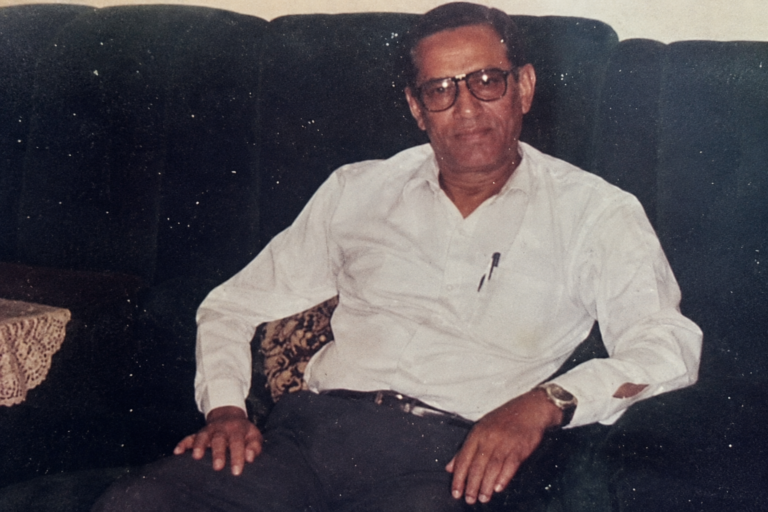
Sultan Ahmed (Photo: ARNO, Rohingya Belong to Burma, 2009)
Sultan Ahmed was a Rohingya lawyer, legislator, and political strategist who served as one of the longest-tenured parliamentarians from Arakan during Burma's democratic era. President of the North Arakan Jamiat-e-Ulema, a member of the 1947 Constituent Assembly, a four-time Member of Parliament for Maungdaw, and Parliamentary Secretary to the Ministry of Minorities with the rank of Deputy Minister, Ahmed spent a decade at the center of the constitutional battle over Rohingya citizenship, before leading refugee welfare efforts in exile after 1978.
At a Glance
Early Life in Maungdaw
Sultan Ahmed was born in 1901 in the village of Thay Chaung, also known as Balukhali or Molvi Para, in Maungdaw Township, northern Arakan, British Burma. He was born into an influential landed family; his father, Maulana Akram Uddin, was a respected local landlord and Islamic scholar. That background gave Ahmed access to formal elite education across British India at a time when Western-style higher education remained largely out of reach for rural borderland populations.
He began his secondary education at the Government Muslim High School in Chittagong, matriculating in 1919, then went on to the University of Calcutta, graduating with a Bachelor of Arts in 1924. To enter the legal profession, he enrolled at Rangoon University and earned his Bachelor of Laws in 1929.
Law and Colonial Civil Service
On December 2, 1930, Ahmed enrolled as a Higher-Grade Pleader, building a legal practice that spanned both Rangoon and Akyab, giving him a close working knowledge of colonial property law and administrative disputes, and of how administrative law shaped ethnic and religious identity in British Burma.
In December 1942, during the Japanese occupation and the intercommunal turmoil it brought to Arakan, Ahmed moved into administrative service as an Assistant Township Officer in Maungdaw, a post he held until June 1946. After the Allied liberation, he joined the Judicial Department as a First Class Magistrate under the British Military Administration and was admitted as an Advocate of the High Court in Rangoon, combining administrative authority, judicial standing, and legal training that positioned him as a leading spokesperson for northern Arakan's Muslim community as independence negotiations began.
The Jamiat-e-Ulema and the 1947 Constituent Assembly
Post-war northern Arakan was politically unstable, split between factions favoring union with East Pakistan, the emerging Mujahideen rebellion, and moderates seeking constitutional integration into the future Union of Burma. Ahmed became a leading voice among the moderates, working through the North Arakan Jamiat-e-Ulema, the regional Council of Islamic Scholars, as its President.
On February 24, 1947, operating from the Jamiat-e-Ulema's headquarters in Maungdaw, Ahmed submitted a detailed memorandum to Arthur G. Bottomley, the British Under-Secretary of State for Dominions, with copies forwarded to the Governor of Burma, the Secretary of State in London, and Aung San's AFPFL. The memorandum described the distinct demographic character of northern Arakan, comprising Maungdaw, Buthidaung, and western Rathedaung, where Muslims formed an absolute majority, and pointed to earlier commitments from British military authorities on local self-determination. When British authorities dismissed proposals for an autonomous Muslim state or partition as impractical, Ahmed shifted strategy toward securing constitutional guarantees within Burma itself.
In the April 1947 Constituent Assembly elections, Ahmed and his political colleague M. A. Gaffar were elected to represent the Akyab District North / Maungdaw constituencies. On January 4, 1948, as Burma formally became independent, Ahmed took the oath of allegiance as a member of the new Union Parliament.
The June 1948 Memorandum
When conservative factions in the new government tried to reclassify Arakanese Muslims as non-indigenous "Chittagonian" residents, Ahmed, as President of the North Arakan Jamiat-e-Ulema, submitted a formal protest memorandum to Prime Minister U Nu on June 18, 1948. He argued that labeling Arakanese Buddhists indigenous while calling Muslims foreign relied on an artificial religious distinction, not historical reality, and pointed to the community's full participation in the anti-fascist movement and the 1947 elections. President Sao Shwe Thaike and U Nu accepted the argument, formally recognizing Arakanese Muslims as an indigenous ethnic group of the Union.
A Decade in Parliament
Ahmed aligned the Jamiat-e-Ulema with the ruling AFPFL, positioning himself as a key parliamentary partner to Prime Minister U Nu. His electoral record in Maungdaw held across three general elections after independence: he won the Chamber of Deputies seat for Maungdaw-1 in 1951, was re-elected in 1956 alongside U Abul Khair, and won again in 1960, serving continuously until parliament's dissolution in 1962.
In 1951, his wife, Daw Aye Nyunt, also known as Zura Begum, won her own parliamentary seat representing Maungdaw, making them one of the earliest husband-and-wife legislative teams in post-colonial Southeast Asia.
In recognition of his legislative tenure and his role securing Muslim minority support for the AFPFL, Ahmed was appointed Parliamentary Secretary to the Ministry of Minorities, a post that under Burma's Westminster-style constitution carried the rank and authority of a Deputy Minister. He held the position continuously from October 1949 to September 1959, with his portfolio expanding into the Ministry of Relief and Resettlement and the Ministry of Social and Religious Affairs, one of the longest tenures of any Parliamentary Secretary in post-independence Burmese history. In this role, he managed inter-communal relief efforts, oversaw state aid to border communities, and advocated for the administrative integration of northern Arakan.
The Arakan Statehood Question
The central political debate in western Burma through the 1940s and 50s was the Arakan Statehood Question. Arakanese Buddhist politicians, led by figures such as U Seinda and the Arakan National United Organization, pushed for a unified Arakan State within the Union. Northern Arakan's Muslim population opposed being absorbed into an autonomous, Buddhist-dominated state without explicit constitutional protection, fearing political marginalization and land alienation.
To address the tension, U Nu established a special inquiry commission headed by Chief Justice Sir Ba Oo. Ahmed was appointed to its Arakan Sub-Committee, serving alongside regional leaders Kyaw Yin, San Tun Aung, and Tha Tun, presenting data on northern Arakan's distinct demographic, linguistic, and cultural profile. On October 29, 1948, the sub-committee recommended a constitutional compromise instead of full statehood: a dedicated Ministry of Arakan Affairs, a constitutionally recognized Arakan Affairs Council of all Arakan's elected MPs, and a special frontier administration framework, groundwork that would eventually produce the Mayu Frontier Administration in May 1961, placing Maungdaw, Buthidaung, and western Rathedaung under direct central administration.
Comparing the Early Rohingya Parliamentarians
Ahmed served alongside a small group of Rohingya legislators who together shaped Burma's democratic-era minority politics.
| Figure | Constituency | Key Terms | Core Legacy |
|---|---|---|---|
| Sultan Ahmed | Maungdaw / Akyab District North | 1947 Assembly; 1951, 1956, 1960 Parliament | Parl. Secretary, Ministry of Minorities; author of the June 1948 memorandum |
| M. A. Gaffar | Maungdaw / Buthidaung | 1947 Assembly; 1951, 1956 Parliament | Submitted the 1949 "Rohingya Memorandum" to the Regional Autonomy Enquiry Commission |
| Sultan Mahmud | Buthidaung North | 1956, 1960 Parliament | Union Minister of Health; architect of the Mayu Frontier Administration |
| Abdul Bashor | Buthidaung | 1951, 1956, 1960 Parliament | Parliamentary Secretary; AFPFL organizer in northern Arakan |
| Daw Aye Nyunt (Zura Begum) | Maungdaw | 1951 Chamber of Deputies | Spouse of Sultan Ahmed; among the earliest female Muslim legislators in Southeast Asia |
The 1962 Coup, Nagamin, and Exile
Burma's democratic era ended abruptly on March 2, 1962, when General Ne Win's military coup suspended the 1947 Constitution and dissolved parliament. The new Revolutionary Council abolished the Mayu Frontier Administration, removed Rohingya officers from civil administration, shut down Rohingya-language broadcasting on the Burma Broadcasting Service, and began restricting movement and land rights in northern Arakan. Ahmed's formal political career ended with the coup, as every parliamentary office and secretaryship was abolished.
In 1977-78, the military launched Operation Nagamin, a campaign of national registration checks that produced widespread violence, arbitrary arrests, and the forced expulsion of more than 200,000 Rohingya into Bangladesh. Despite his advanced age, Ahmed joined that exodus in 1978. Drawing on his legal and administrative background, he took on leadership of the Rohingya Refugee Welfare Organisation as its President, coordinating international humanitarian relief, submitting documentation to the United Nations and the Bangladeshi government on human rights abuses in Arakan, and advocating for safe repatriation with full citizenship rights.
Final Years and Death
Sultan Ahmed spent his final years in exile in Chittagong, Bangladesh, continuing humanitarian and political advocacy for his displaced community. He died on March 2, 1981, at the age of 80, marking the end of an era of constitutional parliamentary advocacy carried by British-trained Rohingya lawyers who had directly participated in founding the post-colonial Union of Burma.
Legacy
Ahmed's career shows that Rohingya political presence in democratic Burma was not marginal, but integrated into the highest levels of governance, constitutional drafting, cabinet-level appointments, and legislative committee work. His June 1948 memorandum stands as clear documentary evidence that the post-independence state recognized Arakanese Muslims as full citizens entitled to equal franchise and parliamentary representation, a status later reversed entirely by the 1982 Citizenship Law, which excluded the Rohingya from Myanmar's list of 135 recognized national races.
His later transition from Parliamentary Secretary in Rangoon to refugee welfare leader in Chittagong foreshadowed the broader trajectory of the Rohingya population over the following decades, and the legalistic, documentation-based strategy he practiced still underpins Rohingya rights advocacy before international bodies today, including the International Court of Justice.
Complete Timeline
Tap any year for the fuller account.
1901+
1924+
1929+
1930+
1942-46+
Feb 1947+
Apr 1947+
Jun 1948+
Oct 1948+
1949-59+
1951, 1956, 1960+
May 1961+
Mar 1962+
1978+
Mar 2, 1981+
Sources & Bibliography
This profile is built from British colonial archival records, Burmese parliamentary history, and secondary scholarship on Arakan and Rohingya political history.
- Wikipedia — Sultan Ahmed (Burmese politician).
en.wikipedia.org - TOAEP — A Critical Assessment of the Exhibition "Burma's Path to Genocide," by Derek Tonkin.
toaep.org - Network Myanmar — Rohingya Belong to Burma (ARNO, 2009).
networkmyanmar.org - Online Burma Library — Jamiatul-Ulama, North Arakan: Representations to Mr. Bottomley, Feb 24, 1947.
burmalibrary.org - New Mandala (ANU) — Making Rohingya Statelessness.
newmandala.org - Network Myanmar — Submission dated 24 February 1947 (Jamiat).
networkmyanmar.org - ResearchGate — The Politics of Rohingya Ethnicity: Understanding the Debates on Rohingya in Myanmar.
researchgate.net - US Holocaust Memorial Museum — Evidence of Belonging, Burma's Path to Genocide.
exhibitions.ushmm.org - Daily Sabah — Rohingya diaspora take determined steps to regain their rights.
dailysabah.com - International Court of Justice — Public sitting record, Dec 12, 2019.
icj-cij.org - Burma Partnership — Arakan Rohingya Union press statement.
burmapartnership.net