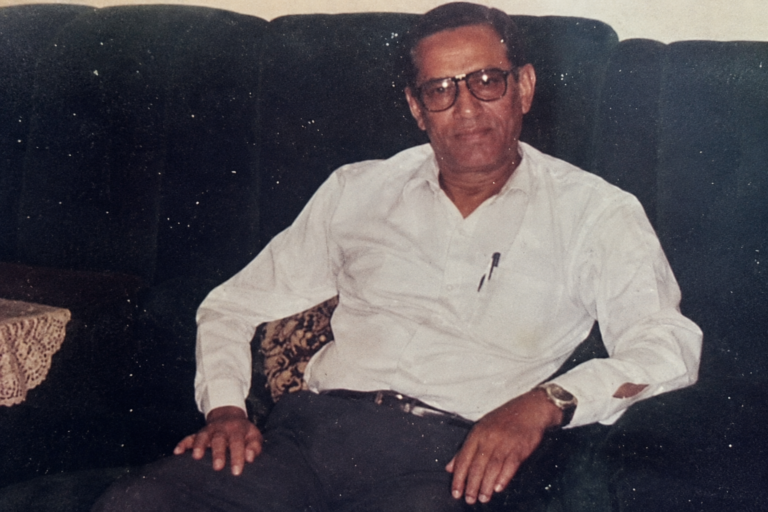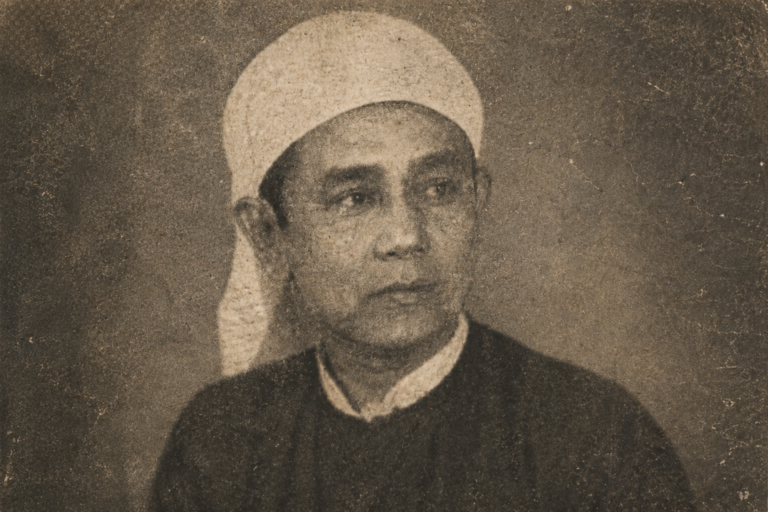
Co-Founder of the National Democratic Party for Human Rights, Senior Administrator for Médecins Sans Frontières, and Community Leader of the Thet Kae Pyin IDP Camp

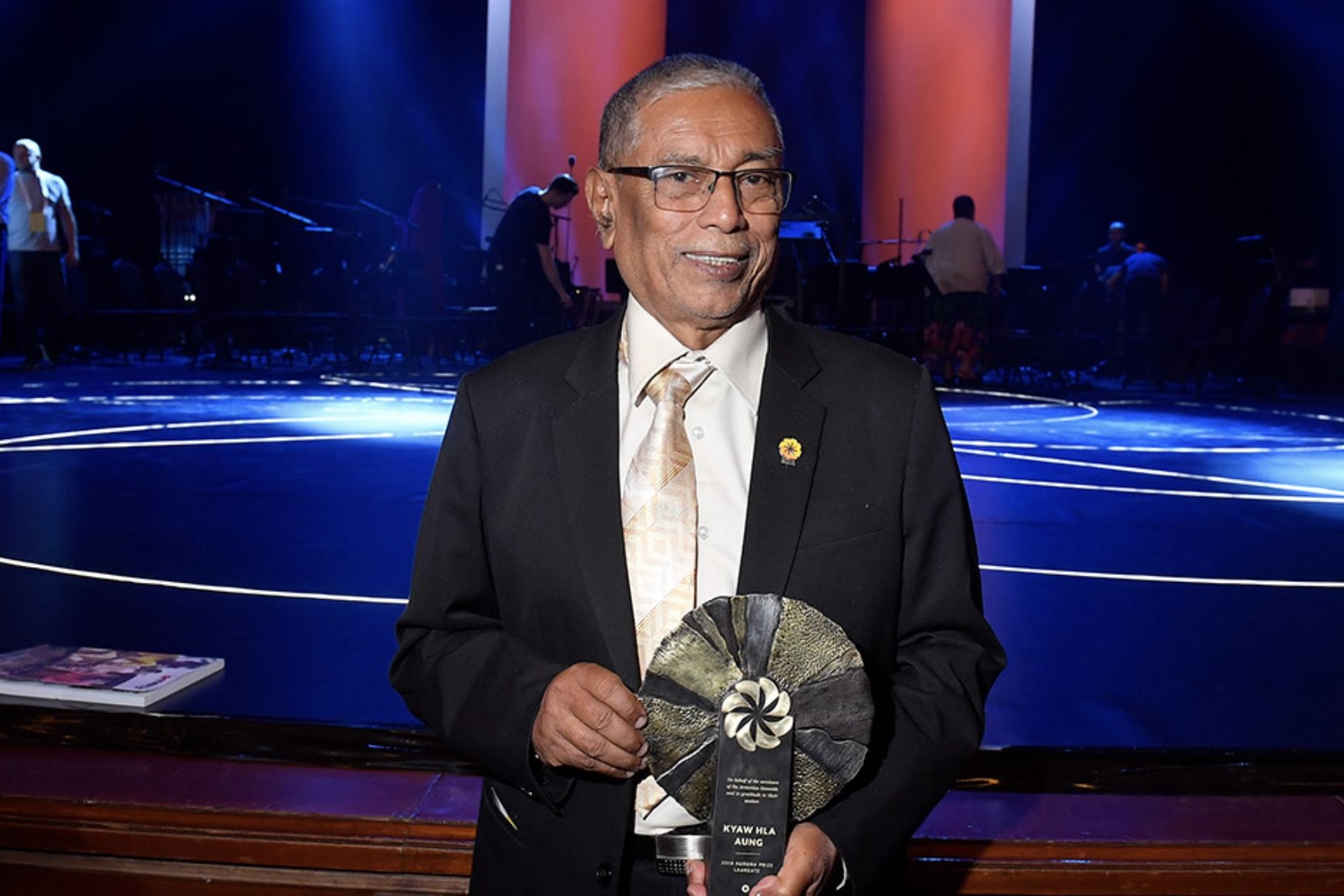
U Kyaw Hla Aung at the 2018 Aurora Prize ceremony in Yerevan, Armenia (Photo: Aurora Humanitarian Initiative)
U Kyaw Hla Aung, born Muhammad Kasim, was a Rohingya lawyer, civil rights advocate, political leader, and humanitarian from Sittwe. Operating across six decades of changing political regimes, from Burma's post-independence constitutional era, through Ne Win's socialist dictatorship, decades of military rule under SLORC and the SPDC, the quasi-civilian Thein Sein administration, and the civilian NLD government, he worked as a High Court pleader, co-founder of the National Democratic Party for Human Rights, senior administrator for Médecins Sans Frontières, and leader within internally displaced persons camps, using the rule of law to counter institutionalized disenfranchisement, land confiscation, and social exclusion. He endured a combined twelve to sixteen years of arbitrary imprisonment across multiple decades as a recognized prisoner of conscience, maintaining a non-violent, legalistic defense of Rohingya citizenship throughout, before receiving the 2018 Aurora Prize for Awakening Humanity.
At a Glance
Early Life, Legal Formation, and Judicial Service
Kyaw Hla Aung was born on 16 August 1940 in Sittwe, the provincial capital of Arakan (now Rakhine State), during the final years of British colonial rule in Burma. Born into an educated Muslim family, his father, U Yusuf, served for over forty years as Head Clerk within the Sittwe district state court system, while his mother was Daw Gul Badan. The administrative position held by his father exposed him to legal bureaucracy and court protocols during his formative years.
During this early post-colonial era, Rohingya Muslims actively participated in the judicial, administrative, and parliamentary affairs of Burma, a period of institutional inclusion that established the backdrop for Kyaw Hla Aung's own later understanding of civil rights and constitutional belonging.
After completing his primary and secondary education in Sittwe, Kyaw Hla Aung entered public service in 1960, securing employment within the local judicial hierarchy. Between 1961 and 1965, he worked as a court clerk in the Sittwe District Civil Court and Section Judge Court, subsequently advancing to the role of court stenographer in 1965. He served in these judicial staff capacities for twenty-four years in total.
During his decades as a judicial staff member, Kyaw Hla Aung witnessed an increase in institutionalized discrimination targeting ethnic minorities following General Ne Win's 1962 military coup. Discrimination within state institutions intensified with the promulgation of the 1982 Burma Citizenship Law, which established a three-tiered citizenship structure (Full, Associate, and Naturalized) tied to an official list of 133 national indigenous races (taingbyithaye), from which the Rohingya were excluded.
Recognizing that administrative avenues for redress were closing, Kyaw Hla Aung resigned from his civil service post to acquire formal legal credentials. He completed his legal training and passed the Higher Grade Pleader examination in 1982, and was admitted as a lawyer in the Rakhine State High Court, focusing his practice on civil litigation, property disputes, and basic human rights claims on behalf of marginalized communities in Sittwe and adjacent townships.
Political Mobilization and State Repression
In 1986, the Myanmar military government initiated land confiscation measures across northern Rakhine State to construct military installations and state-sponsored resettlement villages known as Natala. Representing a collective of Rohingya farmers whose ancestral agricultural plots had been seized without compensation, Kyaw Hla Aung drafted legal appeals directly challenging the state's actions. In response, state security forces arrested him under Section 5 of the 1950 Emergency Provisions Act, a statute used by successive regimes to criminalize acts deemed detrimental to state security. He was held in Sittwe Prison and Rangoon's Insein Prison for two years, before being released in 1988 amid the widespread civil unrest of the 8888 Democratic Uprising.
Following the suppression of the 1988 democratic movement and the formation of the State Law and Order Restoration Council (SLORC), military authorities announced general elections for May 1990. Kyaw Hla Aung co-founded the National Democratic Party for Human Rights (NDPHR) alongside Rohingya political leaders including U Kyaw Min. The party registered to contest parliamentary constituencies in Rakhine State, advocating for the restoration of constitutional citizenship, civil rights, and regional development.
Kyaw Hla Aung was selected as an official NDPHR candidate for a Sittwe parliamentary seat. To neutralize his political candidacy, the military junta re-arrested him prior to the vote under Section 5 of the Emergency Provisions Act. The Sittwe District Court sentenced him to fourteen years' imprisonment. While the NDPHR won four parliamentary seats in northern Rakhine State during the 1990 election, SLORC invalidated the electoral outcomes, banned the party, and detained its leadership. Kyaw Hla Aung's prison sentence was subsequently reduced to ten years on appeal, and he served seven years before being released under a conditional presidential amnesty in 1997.
Upon his release in 1997, Kyaw Hla Aung was prohibited from re-establishing his formal legal practice. Consequently, he redirected his administrative and legal background toward humanitarian assistance, joining the Sittwe office of Médecins Sans Frontières (MSF-Holland) as a senior administrator. In this capacity, he facilitated medical relief logistics, negotiated travel permits for emergency healthcare workers through regional military checkpoints, and documented health conditions within marginalized rural Rohingya communities. His double perspective as a former court administrator and political prisoner allowed MSF to navigate the legal regulations imposed by military authorities on international non-governmental organizations operating in Rakhine State.
Inter-Communal Crisis and Forced Internment
In June and October 2012, waves of inter-communal violence swept Rakhine State, leading to the destruction of urban Muslim quarters in Sittwe. Kyaw Hla Aung's ancestral residence was burned, destroying his legal files, historical documents, and personal possessions. Over 120,000 Rohingya residents of Sittwe were forcibly relocated by state security forces into designated internally displaced persons (IDP) camps situated outside the city perimeter. Kyaw Hla Aung was relocated to the Thet Kae Pyin IDP Camp, where he was selected by camp residents to serve as a senior community leader and administrator. In this position, he organized informal educational structures, coordinated medical evacuations, and communicated camp conditions to visiting foreign delegations, journalists, and United Nations representatives.
In early 2013, the Ministry of Immigration and Population launched a pilot identification drive in Rakhine State IDP camps. The program required Rohingya residents to fill out National Verification Cards (NVC) listing their ethnicity as "Bengali," a legal classification implying foreign status from Bangladesh. Kyaw Hla Aung publicly opposed this policy, asserting that accepting the "Bengali" classification would permanently forfeit constitutional claims to indigenous status and validate state efforts to brand the population as illegal immigrants.
On 26 April 2013, peaceful resistance to the verification exercise turned into public protests at the Bauddua IDP camp when immigration officials attempted to force registration. Although Kyaw Hla Aung was not present at the site of the confrontation, he intervened via telephone with local youth leaders to de-escalate tensions and discourage violence. Despite his attempt to prevent conflict, state authorities targeted Kyaw Hla Aung as an alleged instigator of the April 2013 protests. After several months in hiding, he was arrested by Special Branch officers on 15 July 2013, the same day President Thein Sein declared in London that all political prisoners in Myanmar would be freed by the end of the year.
During his incarceration in Sittwe Prison, the 74-year-old activist suffered from severe hypertension, gastric conditions, and chronic arthritis exacerbated by poor detention conditions and inadequate access to medication. Human rights organizations, including Amnesty International, the International Federation for Human Rights (FIDH), and the Assistance Association for Political Prisoners (AAPP), launched campaigns demanding his release, designating him a prisoner of conscience.
| Parameter | Details of the 2013-2014 Detention |
|---|---|
| Date & Location of Arrest | 15 July 2013, Sittwe Township, by Special Branch personnel |
| Detention Facility | Sittwe District Prison |
| Initial Charges | Penal Code Arts. 109 (Abetting), 148 (Rioting with a Deadly Weapon), 150 (Unlawful Assembly) |
| Additional Charges Added | Penal Code Arts. 332 (Hurt to Public Servant), 333 (Grievous Hurt to Public Servant), 395 (Dacoity), 505(b) (Public Mischief) |
| Procedural History | Section 505(b) dropped 30 Dec 2013; Supreme Court remanded the case to Sittwe District Court on 8 Jan 2014 |
| Final Sentence & Release | Sentenced 26 Sept 2014 to 18 months under Section 147 (Rioting); released 7 Oct 2014 under presidential amnesty |
A Record of Four Imprisonments
Kyaw Hla Aung endured repeated incarcerations designed to curtail his legal defense work and political candidacy, with state security mechanisms adapting emergency decrees and penal statutes across different political regimes to neutralize legal advocacy.
| Period | Statute | Underlying Activity | Location & Duration | Outcome |
|---|---|---|---|---|
| 1986-88 | Emergency Provisions Act, S.5 | Legal petitions against state land confiscation for Rohingya farmers | Sittwe & Insein Prisons; 2 years | Released in 1988 Uprising amnesties |
| 1990-97 | Emergency Provisions Act, S.5 | Co-founding the NDPHR; parliamentary candidacy | Insein & Sittwe Prisons; 14-year sentence reduced to 10, served 7 | Conditional presidential amnesty, 1997 |
| 2012 | Penal Code, S.505(b) | Preemptive detention during June 2012 Sittwe violence | Sittwe Detention Center; ~2 months | Released August 2012 |
| 2013-14 | Penal Code, S.147 (of 7 charged) | Alleged instigation of April 2013 NVC protests | Sittwe District Prison; 1 year, 3 months | 18-month sentence; released 7 Oct 2014 |
International Laureate and Humanitarian Philanthropy
In 2018, Kyaw Hla Aung was named the Laureate of the Aurora Prize for Awakening Humanity, an international humanitarian award established in Yerevan, Armenia, on behalf of the survivors of the Armenian Genocide. The Selection Committee, which included human rights leaders such as former UN High Commissioner for Human Rights Mary Robinson, cited his decades-long dedication to non-violent human rights defense, legal education, and civil advocacy under authoritarian conditions.
In accordance with the Aurora Prize guidelines, the $1.1 million financial award was directed toward international organizations selected by the Laureate. Kyaw Hla Aung re-allocated the entire sum to three non-governmental organizations providing medical relief, education, and protection services to Rohingya refugees and internally displaced persons. The initiatives funded by this re-allocation provided direct and indirect assistance to an estimated 375,000 to 390,000 Rohingya refugees across South and Southeast Asia.
| Recipient Organization | Focus Area | Operational Locations | Impact |
|---|---|---|---|
| Médecins Sans Frontières (MSF) | Primary healthcare, clinical operations, maternal care, emergency medical evacuations | Rakhine State, Myanmar; Cox's Bazar, Bangladesh | Expanded emergency clinic operations and medical supplies servicing over 100,000 refugees |
| MERCY Malaysia | Mobile health clinics, clean water infrastructure, maternal health initiatives | Displaced settlements in Myanmar and South/Southeast Asian transit camps | Health screening, primary consultation, and clean water access for vulnerable families |
| International Catholic Migration Commission (ICMC) | Refugee Protection Corps, language training (English/Malay), emergency grants | Urban refugee populations in Malaysia and Southeast Asian diaspora communities | Funded education, digital literacy, and community protection programs |
Following his selection as the 2018 Aurora Laureate, Kyaw Hla Aung used his international visibility to advocate for Rohingya educational access and citizenship rights. In interviews with international media, he emphasized that denial of formal state education was part of a deliberate government strategy to enforce illiteracy, diminish civic capacity, and make the community vulnerable to false claims of foreign origin.
In 2019, Fortune Magazine ranked Kyaw Hla Aung 28th on its annual list of the "World's Greatest Leaders." That same year, HayPost, the official postal operator of Armenia, issued a commemorative postage stamp bearing his likeness as part of its global humanitarian series.
Final Years and Death
After receiving the Aurora Prize in Yerevan, Kyaw Hla Aung returned to Rakhine State, choosing to reside within the Thet Kae Pyin IDP camp rather than live abroad. He continued to serve as a camp leader, mediating local disputes, organizing informal community schools, and coordinating with international relief agencies.
As his health deteriorated due to chronic heart disease, kidney complications, and severe arthritis, medical facilities in Sittwe proved insufficient under the travel restrictions imposed on Rohingya residents. In late 2020, after obtaining regional security clearances, he relocated to Yangon to receive specialized medical treatment. On 31 July 2021, Kyaw Hla Aung died from natural causes at a medical facility in Botahtaung Township, Yangon, at the age of 80. His passing was observed by international human rights organizations, refugee advocacy networks, and Rohingya diaspora communities worldwide. Kyaw Hla Aung was married and had seven children.
Legacy
Kyaw Hla Aung's persistent reliance on litigation and administrative appeals demonstrates a commitment to legalist resistance within an authoritarian framework. Rather than abandoning judicial mechanisms as state institutions became increasingly oppressive, he used court procedures, petition writing, and statutory appeals to build a documentary record of state overreach and land confiscation, a legal strategy that preserved evidence for future international accountability efforts while maintaining a non-violent framework for local resistance.
His focus on education points to a structural understanding of how state-enforced illiteracy intersects with disenfranchisement. He repeatedly argued to foreign journalists and human rights bodies that denying Rohingya youth access to formal schooling served a specific state policy: by stripping the population of educational credentials and legal literacy, the state made it easier to label them non-indigenous "Bengali" migrants lacking historical roots in the region, and his efforts to establish informal schools within the IDP camps aimed directly to counter that.
His carceral timeline underscores the continuity of state persecution across fundamentally different governance systems in Myanmar. Whether under the military junta of the late 1980s, the ruling council of the 1990s, or the quasi-civilian reformist government of the 2010s, state security forces consistently employed similar statutory measures, Emergency Provisions and Penal Code public mischief charges, to silence legal advocates, revealing that the structural exclusion of the Rohingya was a sustained institutional policy rather than the byproduct of a single regime.
Finally, his decision to direct the $1.1 million Aurora Prize grant to established non-governmental organizations created an operational bridge between international recognition and local relief. By channeling resources directly into primary healthcare, sanitation, and refugee protection corps across Myanmar, Bangladesh, and Malaysia, his award sustained vital infrastructure for hundreds of thousands of displaced persons, a defining model of non-violent legal defense, civic leadership, and humanitarian service under systematic state persecution.
Complete Timeline
Tap any year for the fuller account.
1940+
1960+
1982+
1986-88+
1990-97+
1997+
2012+
2013-14+
2018+
2019+
Jul 31, 2021+
Related Figures
To read more about other Rohingya parliamentarians and political leaders of Burma's post-independence era:
Sources & Bibliography
This profile is built from human rights organization records, award and institutional archives, and Rohingya and international press coverage.
- Rohingya Khobor — Kyaw Hla Aung: A Prominent Rohingya Lawyer, Human Rights Defender, and Activist.
rohingyakhobor.com - Wikipedia — Kyaw Hla Aung.
en.wikipedia.org - Aurora Luminaries — Kyaw Hla Aung (1940-2021).
auroraluminaries.com - ICMC — Kyaw Hla Aung: A Life of Selfless Struggle for the Rohingya People.
icmc.net - Assistance Association for Political Prisoners (AAPP) — Political Prisoner Profile.
aappb.org - Amnesty International — Further Information: Elderly Activist Still Detained, Health at Risk: Kyaw Hla Aung.
amnesty.org - FIDH — Burma: Kyaw Hla Aung Released in Amnesty.
fidh.org - Gariwo — Kyaw Hla Aung, lawyer and activist, biography (Italian).
it.gariwo.net - Mirror-Spectator — Rohingya Human Rights Activist Kyaw Hla Aung Passes Away.
mirrorspectator.com - Wikidata — Kyaw Hla Aung.
wikidata.org - Aurora Prize — Kyaw Hla Aung, Aurora Prize Laureates (video).
youtube.com