Even after years of paperwork, brokers, and payments, most are still labeled "Bengali," not Rohingya

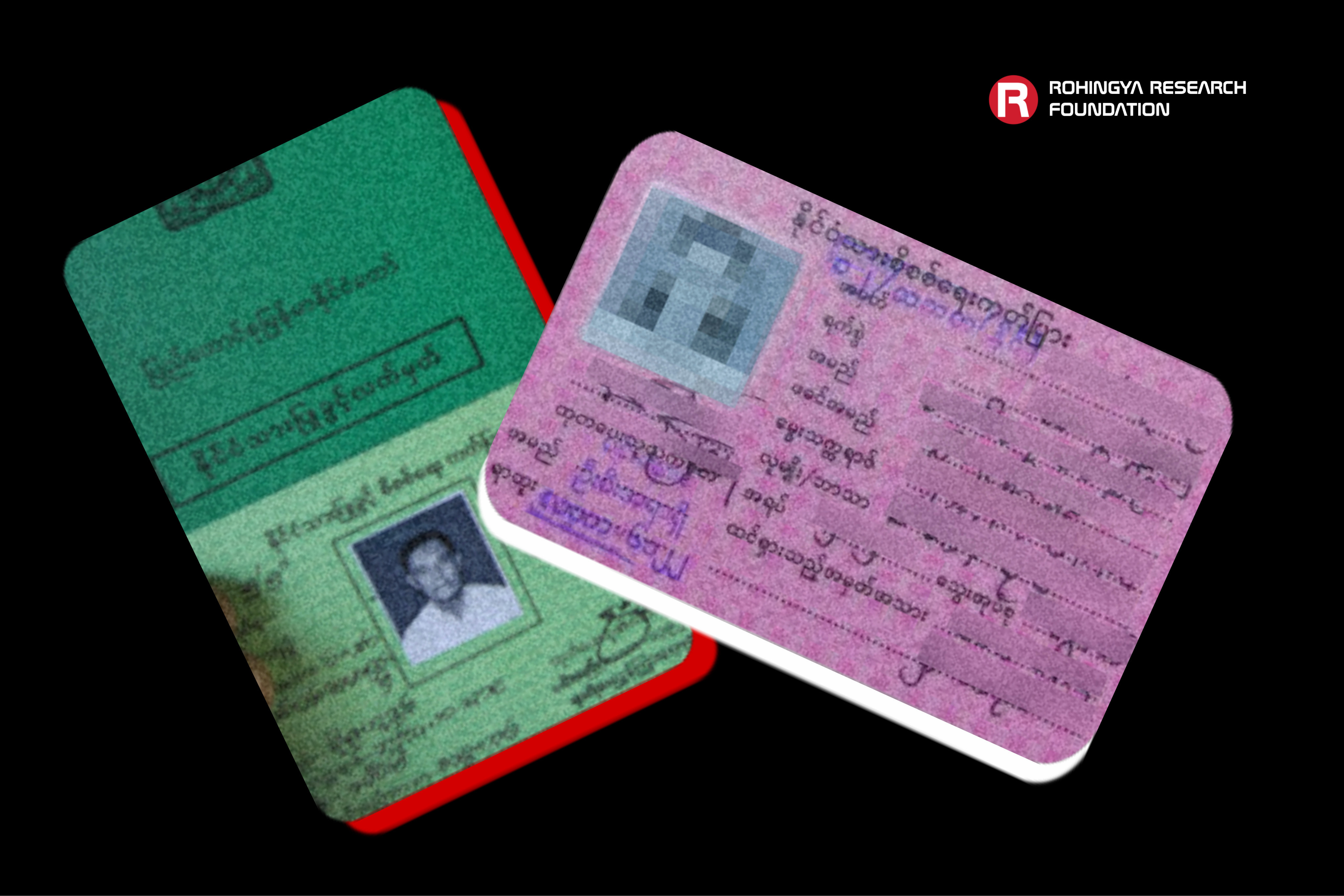
Green Card (naturalized citizenship) on the left, Pink Card (full citizenship) on the right
For many Rohingya in Myanmar, getting a citizenship card is a long and difficult process. It can take months, sometimes over a year, and often comes with heavy costs along the way. Here is a plain look at how the process actually works.
What is a citizenship card?
In Myanmar, the official document that shows a person’s citizenship status is called a Citizenship Scrutiny Card, though it is often referred to as an NRC, or National Registration Card. It is used to prove legal identity and can affect access to things like education, jobs, and government services.
How the process works
Getting this card usually means passing through several layers of government, starting small and moving up.
It often begins at the village level, where a person needs approval from the village administration before they can move forward. For those living in remote areas, even this first step can be hard, since travel costs money and time.
Next comes the town level, where the applicant goes to the town immigration office and fills out ancestral forms. These forms usually require detailed information going back several generations, covering parents, grandparents, and even great-grandparents, including their addresses, citizenship status, and ID card numbers.
This step is rarely straightforward for a Rohingya applicant. While people from other ethnic groups can often pass through this stage without much trouble, Rohingya usually have to go through a broker, often another Rohingya with connections to the immigration office, or someone Rakhine, and pay that broker just to get the file submitted to the office. Not every Rohingya is able to do this. Those who do manage it tend to be people with more education, or people with some means to travel or connections outside their home area, such as in Yangon.
Family records matter a great deal at this stage. Someone with a clear family history or documented lineage tends to move through this stage more easily than someone without one.
After the town level, the application is supposed to move on for further checks at the township and state levels, where officials examine the applicant’s background, identity, and past documents. But in practice, many files never make it that far. They often sit in the town immigration office for months or even years, going nowhere until a large sum of money is paid to the officers handling them. Some applicants have reported that their file was eventually lost inside the office altogether, since officers did not treat the case seriously until payment was made, forcing them to start the entire application over again.
If a file does move forward, it must eventually reach the central government in Naypyidaw before a final decision is made. This stage is especially hard for Rohingya applicants. Files belonging to Rohingya are often left unreviewed unless a large amount of money is paid. Many Rohingya have reported spending at least 5 to 10 million Myanmar kyats to get through this step alone. If the application is finally approved, the paperwork travels back down through each level until it reaches the applicant’s hometown, where final signatures are needed before the card is actually issued.
What kind of card do they actually get?
Even after going through this entire process, the card a Rohingya person receives rarely reflects who they actually are. On the document, their ethnicity is listed as “Bengali,” not Rohingya.
The type of citizenship they are granted also tends to fall short. Most Rohingya, around 90 percent, are only given naturalized citizenship, marked by a green card, even in cases where they present enough ancestral evidence to qualify for more. A much smaller share, roughly 10 percent, are granted full citizenship, marked by a pink card, but even then, their ethnicity is still recorded as “Bengali” rather than Rohingya.
So getting a card does not necessarily mean a person’s identity is recognized. A Rohingya applicant can complete the entire process, pay the costs involved, and still end up holding a document that denies who they are.
Not everyone gets one
Not every Rohingya person who applies ends up with a citizenship card. A number of obstacles can stand in the way. Some families simply don’t have enough money for travel, broker fees, and the payments often demanded at each level. Others are missing paperwork, or have no family tree or historical records to point to. Limited access to education, living far from government offices, bureaucratic delays, and fear of mistreatment during the process all add to the burden. For many, the hardest part is proving their family history or eligibility in the first place.
For families with little money, the repeated trips between village, town, and higher offices, combined with the bribes often required to keep a file moving, can become too expensive to manage. So even someone with a legitimate claim to citizenship may never be able to finish the process.
How long does it take?
There is no fixed timeline. Some people move through the system in a matter of months. Others wait over a year, particularly when files sit unreviewed at the town level or require extra verification further up the chain. It depends heavily on each person’s documents, background, and how much money they are able to pay along the way.