Former Member of Burma's 1947 Constituent Assembly, Member of the Chamber of Nationalities, and Parliamentary Secretary for Health

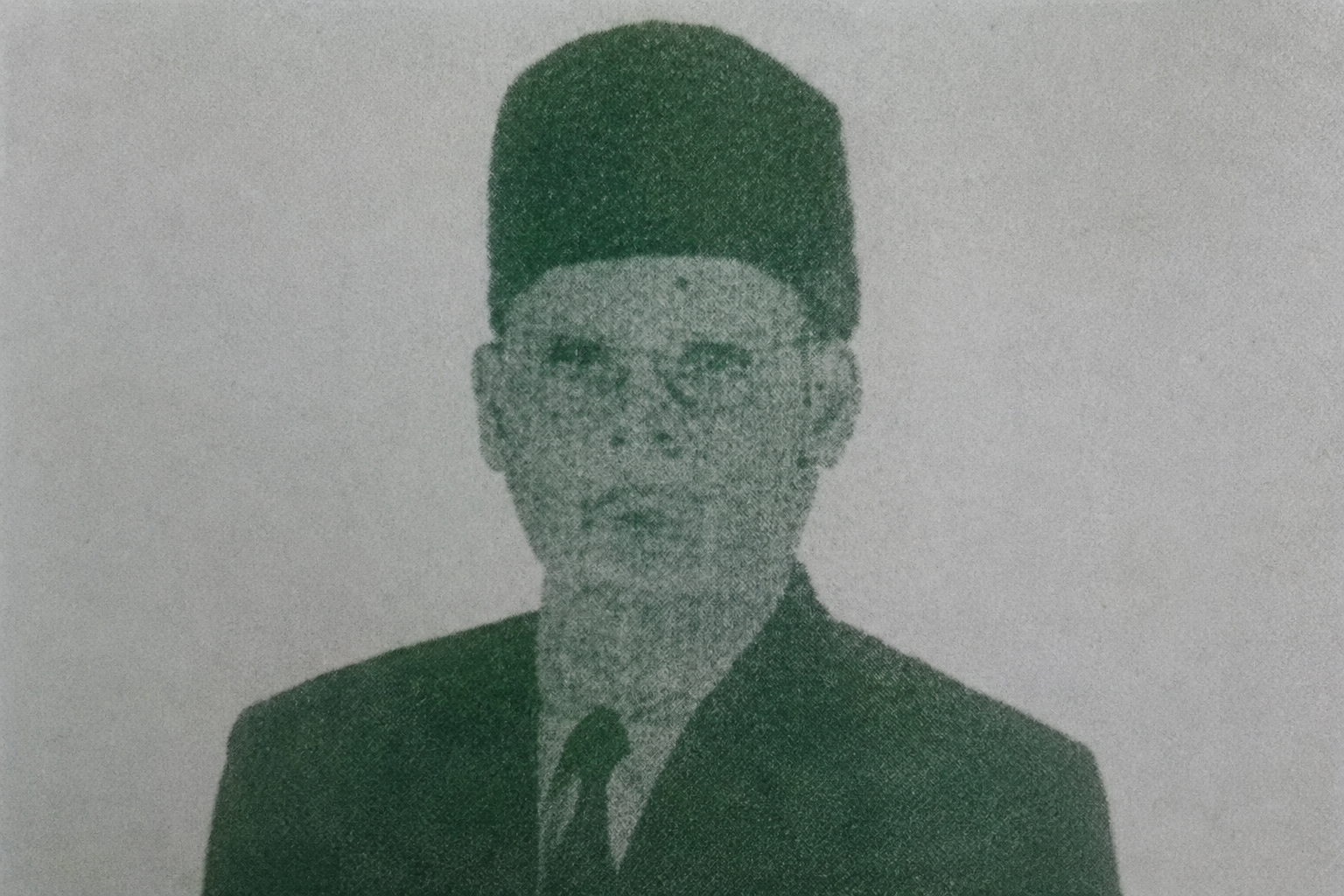
M. A. Gaffar, one of the first Rohingya MPs in Burma (Photo: via Wikimedia Commons)
Mohammed Abdul Gaffar, recorded across British colonial files, Burmese parliamentary records, and the Rangoon press as M. A. Gaffar, was an educator, colonial civil servant, Constituent Assembly delegate, upper house parliamentarian, and cabinet officer in post-independence Burma. He is remembered today for a specific act of documentation: in a 1948 petition and a 1949 government submission, he formally presented the ethnonym "Rohingya" to Burma's central government, describing an indigenous nation of Arakan with its own history, dialect, and culture, in the country's own official record.
At a Glance
Family and Origins
M. A. Gaffar was born into a landed Muslim family in Buthidaung Township, Akyab District, in British-administered Arakan. Colonial administrative records and local biographical accounts identify his father as Ulah Meah, a landholder of standing in the Mayu river basin, part of the established, property-owning stratum of North Arakan's Muslim society, a status that let the family invest in advanced Western and Islamic education for their children at a time when formal literacy in the frontier districts remained limited.
Local biographical records place his precise birth site at the village of Rwanynotaung, near the Mayu River, an area shaped by rice cultivation and trade routes connecting Buthidaung with Maungdaw and Akyab (now Sittwe). The village name itself appears across colonial gazetteers and regional histories under several transliterations, Roanga daung, Rohingyadaung, Rwangya daung, reflecting the same Bengali-Arakanese dialect blend that shaped the wider culture of the Mayu frontier Gaffar grew up in.
Childhood in the Mayu Frontier
Gaffar's early years combined elementary instruction in the village maktab with primary schooling under the British Anglo-Vernacular education system established in Akyab District. Growing up in this bilingual, culturally blended borderland, the local population spoke a distinct regional dialect combining eastern Bengali and Arakanese elements, while practicing Islam alongside traditional rural Arakanese customs, an upbringing that placed Gaffar at the exact cultural intersection his later political writing would try to formally define and protect.
Three Universities, Three Traditions
To obtain advanced credentials, Gaffar's education took him progressively further from Arakan, first to the regional Bengali hub of Chittagong, then to Dacca, then to North India, accumulating a combination of classical Islamic scholarship and modern Western administrative training that made him one of the most formally credentialed Muslim public figures in the Arakan Division of his generation.
| Institution | Location | Year | Qualification |
|---|---|---|---|
| Chittagong Senior Madrasa | Chittagong, Bengal Presidency | 1924 | Classical Islamic studies, with distinction |
| University of Dacca | Dacca (Dhaka), East Bengal | 1930 | B.A., political economy, history & English literature |
| Aligarh Muslim University | Aligarh, North India | 1933 | B.Ed. (B.T.), teacher training |
At Chittagong, rigorous instruction in Arabic grammar, Persian literature, jurisprudence (Fiqh), and theology (Kalam) gave Gaffar formal literacy in Arabic and Persian that he would later draw on when constructing historical arguments about the Islamic heritage of the medieval Arakanese Mrauk-U Kingdom. Dacca, founded in 1921 as a residential university, exposed him to student political movements and constitutional reform debates circulating across eastern British India. Aligarh, the center of Sir Syed Ahmad Khan's modern Islamic pedagogical reform movement, rounded out his training in institutional management and civic advocacy.
Educator, Then Township Officer
Gaffar entered British Burma's educational administration on his return, serving from 1931 to 1942 as District Inspector of Schools for Akyab District, overseeing primary, Anglo-Vernacular, and vernacular schooling across all four townships, distributing government grants-in-aid, evaluating teachers, and expanding rural enrollment in Buthidaung and Maungdaw. The decade built him an extensive personal network among village elders, teachers, and both Muslim and Rakhine Buddhist administrative colleagues across Arakan.
The Japanese invasion of Burma in 1942 collapsed civil administration and triggered communal violence and mass displacement across Arakan. When Allied forces reoccupied North Arakan in 1944, the British Military Administration's Civil Affairs Service appointed Gaffar Township Officer of Buthidaung, serving under Military Administrator Lt. Col. D. C. P. Phelips and Civil Adviser A. A. Shah from 1944 to 1945, managing food relief, land dispute adjudication, and post-war reconciliation.
The February 1947 Maungdaw Meeting
Gaffar's political awakening tracked the 1940 Baxter Report, a Government of Burma commission which explicitly distinguished transient Indian labor migrants from long-settled Arakanese Muslims, describing the latter as indigenous. As Burma moved toward independence under Aung San's AFPFL coalition, that distinction came under direct threat: on 22 February 1947, S. A. S. Tyabji, Advisor on Indian Affairs to the Governor of Burma, proposed grouping all Indian residents, including long-settled Muslim communities, into a single "National Indian Minority."
A Cable to London
On 19 February 1947, a mass meeting of Muslim residents convened in Maungdaw to protest the Tyabji classification. M. A. Gaffar chaired the meeting. The assembly rejected the "Indian" label, asserted the community was indigenous to Burma, and demanded recognition as Burman citizens. Gaffar personally cabled the Secretary of State for Burma in London and the Governor's Executive Council in Rangoon with the assembly's demands, a telegraph preserved today in British Library file IOR/M/4/2605. Two days later, the New Times of Burma reported that Muslims of Burma would not be treated as foreign Indians.
This meeting, documented across British Library files IOR/M/4/2605 and IOR/M/4/2658, stands as direct primary evidence that Gaffar was organizing against foreign-status classification and asserting indigenous identity two months before he ever stood for election.
The 1947 Election & the Constituent Assembly
In April 1947, under Governor Sir Hubert Rance and the terms of the Aung San–Attlee Agreement, Gaffar stood for the Buthidaung constituency while his political colleague Sultan Ahmed contested neighboring Maungdaw. Both ran under the Jamiatul Ulama North Arakan banner, in political cooperation with Aung San's AFPFL. Gaffar won, securing a seat in the body tasked with drafting independent Burma's constitution.
In committee, Gaffar pushed for constitutional language protecting long-settled frontier populations from disenfranchisement. The resulting Article 11 of the 1947 Constitution granted citizenship to persons born in the Union belonging to indigenous races, or whose ancestors had settled in Burma for at least two generations. When Burma became independent on 4 January 1948, the Constituent Assembly became the provisional Union Parliament, and Gaffar was sworn in as a Member of Parliament that same day.
Rejecting the Mujahid Rebellion
Independence brought immediate civil strife: White Flag and Red Flag Communist uprisings, Karen insurgency, and in North Arakan, a Mujahid rebellion led by Cassim, seeking either an autonomous Islamic frontier zone or accession to East Pakistan. Gaffar explicitly condemned the rebellion, arguing that armed violence damaged the Muslim community's political standing, invited harsh military reprisals against rural villages, and alienated Bamar and Rakhine leaders alike. Working through parliament, he and Sultan Ahmed repeatedly called on Mujahid fighters to lay down arms and pursue their goals constitutionally instead.
The 1948 Memorandum, and the Word "Rohingya"
On 20 November 1948, against the backdrop of Mujahid violence and military counter-operations, Gaffar submitted his Memorandum of Appeal to the Principal Secretary of the Government of the Union of Burma, printed in full in The Guardian Daily of Rangoon on 20 August 1951. In it, he appealed to the cabinet to formally recognize Arakanese Muslims as an official national minority under the name "Rohingya," arguing that clear legal status for the peaceful civilian population was essential to isolating armed insurgents and restoring state authority in the Mayu region.
He returned to the same argument in a formal submission to the Regional Autonomy Enquiry Commission on 24 May 1949. Across both documents, Gaffar's usage of the term rested on four consistent elements: an etymology tracing "Rohingya" to Rohang or Rohan, the historical vernacular name for Arakan; an explicit rejection of "Chittagonian" or "Indian" framing in favor of multi-generational, indigenous settlement; a vision of Arakan as a shared homeland of two principal nations, Rakhine Buddhists and Rohingya Muslims; and administrative rather than separatist demands, regional autonomy, minority status, and linguistic protection within the Union of Burma, not an independent state. His own words are worth separating from how they are used today: the memoranda were a political petition appealing for recognition that had not yet been codified into law, not proof of a legal status already granted.
The 1949 Inquiry Commission of Arakan
On 29 July 1949, President Sao Shwe Thaik established the seven-member Inquiry Commission of Arakan to investigate the civil war, communal strife, and administrative collapse in western Burma, and appointed Gaffar as one of its commissioners. Gaffar conducted field investigations and hearings across Akyab, Buthidaung, and Maungdaw, taking testimony from village headmen, merchants, Rakhine leaders, and civil servants. His parallel submission to the Regional Autonomy Enquiry Commission that same year proposed that if Arakan Division were granted statehood, Buthidaung, Maungdaw, and western Rathedaung should form a self-governing district under direct central government jurisdiction, laying the conceptual groundwork for what would become the Mayu Frontier Administration a decade later.
A Decade in the Chamber of Nationalities
Gaffar contested and won both of Burma's regular general elections through the 1950s, sitting in the upper house of parliament for a decade.
| Year | Body | Constituency | Status |
|---|---|---|---|
| 1947 | Constituent Assembly | Buthidaung Township | Elected Representative |
| 1951–52 | Chamber of Nationalities | Akyab West (Akyab North) | Elected Upper House MP |
| 1956 | Chamber of Nationalities | Maungdaw & Buthidaung | Elected Upper House MP |
| 1954–58 | Nu-Tin Cabinet | Central Ministry of Health | Parliamentary Secretary |
In the 1951–52 election he won Akyab West, the northern agrarian hinterlands of Akyab District, questioning ministers on post-war reconstruction funds, frontier police outposts, and rehabilitation of displaced Muslim farmers. Boundary changes in 1956 combined his old base with Maungdaw, and he won a second term representing both townships. Throughout, Buthidaung remained his political home, where he kept a local office handling petitions on land confiscations, police abuses, citizenship delays, and school funding, and personally mediated between military commanders conducting anti-insurgent operations and civilians seeking protection.
Recognizing his administrative background as a former Township Officer and District Inspector, Prime Minister U Nu appointed Gaffar Parliamentary Secretary to the Ministry of Health in the mid-1950s Nu-Tin cabinet, the highest executive position held by an Arakanese Muslim parliamentarian during Burma's democratic era. He answered parliamentary questions on public health budgets, supervised rural dispensary construction, and oversaw anti-malaria campaigns across Arakan, the Shan States, and Tenasserim.
U Nu, Sultan Ahmed, and a Radio Broadcast
Gaffar built a working political alliance with Prime Minister U Nu inside the AFPFL, with U Nu relying on Gaffar and Sultan Ahmed to hold North Arakan stable against Mujahid propaganda. That relationship reached its clearest public moment on 25 September 1954, when U Nu delivered a national radio address explicitly acknowledging the "Rohingya," transcribed in Burmese texts as Ruhinja, as an indigenous Muslim community of Buthidaung and Maungdaw, language that directly echoed Gaffar's own 1948 and 1949 memoranda. When the AFPFL split in 1958 between U Nu's "Clean" faction and the "Stable" faction of Ba Swe and Kyaw Nyein, Gaffar stayed loyal to U Nu.
Alongside U Nu, Gaffar's closest political partnership was with Sultan Ahmed, who sat in the lower Chamber of Deputies and led the Jamiatul Ulama North Arakan on the ground. The two coordinated strategy in Rangoon, issued joint appeals for Mujahid surrender, and petitioned jointly for Mayu region protections, Ahmed supplying grassroots organizing, Gaffar supplying administrative and legislative drafting skill.
The Mayu Frontier Administration, and 1962
Gaffar's 1949 proposal for a self-governing Mayu district bore fruit in May 1961, when U Nu's government established the Mayu Frontier Administration, a special district covering Maungdaw, Buthidaung, and western Rathedaung, governed directly by central officers independent of the Arakan Divisional administration in Akyab.
It lasted less than a year in that form. On 2 March 1962, General Ne Win's military coup overthrew U Nu's government, suspended the 1947 Constitution, and dissolved parliament outright. The Revolutionary Council abolished civilian political parties, dismantled the Mayu Frontier Administration, and replaced elected representatives with military commanders, an abrupt end to the entire democratic mechanism through which Gaffar had built his career.
Final Years and Death
Stripped of his parliamentary office, Gaffar retired to Arakan and lived under the surveillance of Ne Win's military intelligence apparatus, watching the rollback of minority representation and the closure of the civic organizations he had spent his career building. He died in 1966, at 55 or 56. Because his death fell under the Revolutionary Council's strict press censorship, no official state obituary appeared in the military-controlled press. He was buried in Arakan according to Islamic rites, mourned quietly across the villages of Buthidaung and Maungdaw as the man who had represented the frontier in Rangoon.
Descendants of his extended family remained in Buthidaung and Akyab for decades afterward, but the successive waves of displacement in Rakhine State, the 1978 Operation Nagamin, the 1991–92 exodus, and the 2017 clearance operations, scattered family records and pushed many relatives into exile in Bangladesh and beyond. No verified public family archive survives in open scholarly literature today.
What Contemporaries Said
Respected as a moderate civic leader offering an alternative to Mujahid armed extremism.
Prime Minister U NuCabinet proceedings & public statementsNoted for administrative integrity and efficiency as Township Officer of Buthidaung.
Lt. Col. D. C. P. Phelips & A. A. ShahBritish Military Administration, 1944–45Rakhine parliamentarians of the era often disputed his proposals for a separate North Arakan administrative unit, but acknowledged his formal educational credentials and his commitment to working through parliamentary procedure rather than around it.
What Later Historians Said
Gaffar's career has been read in three distinct ways since his death. Rohingya historians, including Aman Ullah, A. F. K. Jilani, and Abdul Karim, treat him as a foundational pioneer of Rohingya political rights, citing his 1948 and 1949 memoranda as primary historical proof that the ethnonym and political identity were formally submitted to Burma's central government during the early post-independence period. International academic historians of Southeast Asia, including Robert H. Taylor, Moshe Yegar, Jacques P. Leider, and Derek Tonkin, read him instead as an educated constitutional moderate navigating a complex borderland decolonization, a bridge-builder seeking to integrate frontier Muslims into the Union of Burma through legal, parliamentary means. Modern Myanmar state publications and nationalist historians, by contrast, downplay or contest his claims entirely, framing post-war Muslim political mobilization as foreign Bengali or Chittagonian activity, a framing that colonial archival records like IOR/M/4/2605 directly contradict, since Gaffar was on record rejecting "Indian" or foreign status as early as February 1947.
Historical Significance
As a member of the 1947 Constituent Assembly and a two-term upper house parliamentarian, Gaffar demonstrated that Arakanese Muslims actively participated in the democratic founding of independent Burma. His political writings remain a documentary record of how the Rohingya community defined its own identity and civic demands during decolonization, and his advocacy for equal citizenship, peaceful parliamentary engagement, and administrative protection still functions as a reference point in discussions of citizenship and rights in Myanmar today.
Disputed Claims & Uncertain Information
A source-critical review of the available record surfaces real gaps.
Tap each item below for detail.
Which spelling of his birthplace is correct?+
Do his education and civil service dates actually line up?+
Are the 1948 and 1949 documents the same memorandum?+
What was his 1952 constituency actually called?+
How exactly did he die?+
Complete Timeline
Tap any year for the fuller account.
1910+
1924+
1930+
1931+
1933+
1940+
1944–45+
Feb 1947+
Apr 1947+
4 Jan 1948+
20 Nov 1948+
24 May 1949+
29 Jul 1949+
20 Aug 1951+
1951–52+
1954–58+
25 Sep 1954+
1956+
May 1961+
2 Mar 1962+
1966+
Primary Documents
| Year | Document | Originator | Archive Reference |
|---|---|---|---|
| 1940 | Report on Indian Immigration | James Baxter | British Library IOR/V/27/820/20 |
| 1947 | Report on Indian Minorities | S. A. S. Tyabji | British Library IOR/M/4/2658 |
| 1947 | Telegraphic Protest, Maungdaw Meeting | M. A. Gaffar | British Library IOR/M/4/2605 |
| 1947 | Constituent Assembly Election Returns | Election Officers, Akyab | IOR/M/4/2605; MFM.M.C. 1199B |
| 1948 | Memorandum of Appeal | M. A. Gaffar | Published, Guardian Daily, 20 Aug 1951 |
| 1949 | Regional Autonomy Submission | M. A. Gaffar | Autonomy Commission Records, 24 May 1949 |
| 1949 | Arakan Inquiry Commission Order | President Sao Shwe Thaik | Union Gazette, 29 Jul 1949 |
| 1954 | Prime Minister's Radio Broadcast | U Nu | Burma Broadcasting Service, 25 Sep 1954 |
Source-Reliability Assessment
This profile draws on a source-critical review distinguishing primary archival evidence from secondary and unconfirmed claims.
| Claimed Event | Evidence | Reliability |
|---|---|---|
| Chairing Feb 1947 Maungdaw meeting | British Library IOR/M/4/2605 & 2658 | High |
| Election to 1947 Constituent Assembly | India Office Records; New Times of Burma | High |
| Text of 1948 Memorandum of Appeal | Guardian Daily, 20 Aug 1951 | High (for text) |
| Appointment to 1949 Arakan Commission | Presidential Order; Union Gazette | High |
| Educational degrees (3 institutions) | Biographical profiles, partial alumni records | Moderate |
| Parliamentary Secretary for Health | Union Gazette; Cabinet records | High |
| Exact cause & place of death, 1966 | Online biographical profiles only | Low |
Assessment categories follow standard archival practice: Category A evidence is primary and independently confirmed; Category C is credible secondary biography; Category D is an unconfirmed lead pending further documentation.
Sources & Bibliography
This profile is built on a source-critical reconstruction combining British Library colonial files, Burmese parliamentary and gazette records, contemporary Rangoon press coverage, and secondary scholarship. Archival reference numbers (such as IOR/M/4/2605) are cited inline where they identify a specific primary document. The full source list follows.
- Wikipedia — M. A. Gaffar.
en.wikipedia.org - Network Myanmar — Mr MA Gaffar (1910–1966) MP and His Memorandum.
networkmyanmar.org - Network Myanmar — Exploring the Issue of Citizenship in Rakhine State.
networkmyanmar.org - Ek Khaale — They Did Not Deny Us, Rohingya, Chapter 2.
ekkhaale.org - Transnational Institute — Arakan (Rakhine State).
tni.org - Wikipedia — Arakan Division.
en.wikipedia.org - Ek Khaale — A New Nation, Rohingya Independence, Chapter 4.
ekkhaale.org - Network Myanmar — Submission Dated 24 February 1947 (Jamiat).
networkmyanmar.org - Online Burma Library — Arakan.
burmalibrary.org - ResearchGate — Colonial Wrongs and Access to International Law.
researchgate.net - Dokumen.pub — A Modern History of Southeast Asia: Decolonization, Nationalism and Separatism.
dokumen.pub - Press Information Bureau, India — Development With Dignity Must Be Agenda of Our Nation: Vice President.
pib.gov.in - Cambridge University Press — The Legacies of World War II for Myanmar.
cambridge.org - Network Myanmar — Representations, 1947.
networkmyanmar.org - MERAL, Myanmar — The Mujahid Insurrection in Rakhine Division (1948–1958).
meral.edu.mm - Anadolu Ajansı — Opinion: Aung San Suu Kyi Drives Final Nail in Myanmar's Moral Coffin.
aa.com.tr - Ek Khaale — A New Country, a New Nation, Chapter 4B (Burmese).
ekkhaale.org - NetIPR / Dr. Yunus — A History of Arakan, Past & Present.
netipr.org - TIME — Burma's Aung San Suu Kyi Kicks Off Panglong 21 Summit.
time.com - Constituent Assembly of India — Debates (Proceedings), Volume II.
sansad.in - openDemocracy — The Plight of Rohingyas in Myanmar, the International Community and Aung San Suu Kyi.
opendemocracy.net - TOAEP (Torkel Opsahl Academic EPublisher) — A Critical Assessment of the Exhibition "Burma's Path to Genocide" at the US Holocaust Memorial Museum, by Derek Tonkin.
toaep.org - TOAEP (Torkel Opsahl Academic EPublisher) — Rohingya: The Foundational Years, by Jacques P. Leider.
toaep.org - University of Dhaka — Securitization of "Rohingyas" in Myanmar: An Analysis.
reposit.library.du.ac.bd - USB News24 — Muslims Have Lived in Arakan Since the Early 700s, for Nearly 1,000 Years.
usbnews24.com - Scribd — Arakan's Rohingya Struggle, July 2009.
scribd.com - NetIPR — Muslims of Burma, by Moshe Yegar.
netipr.org