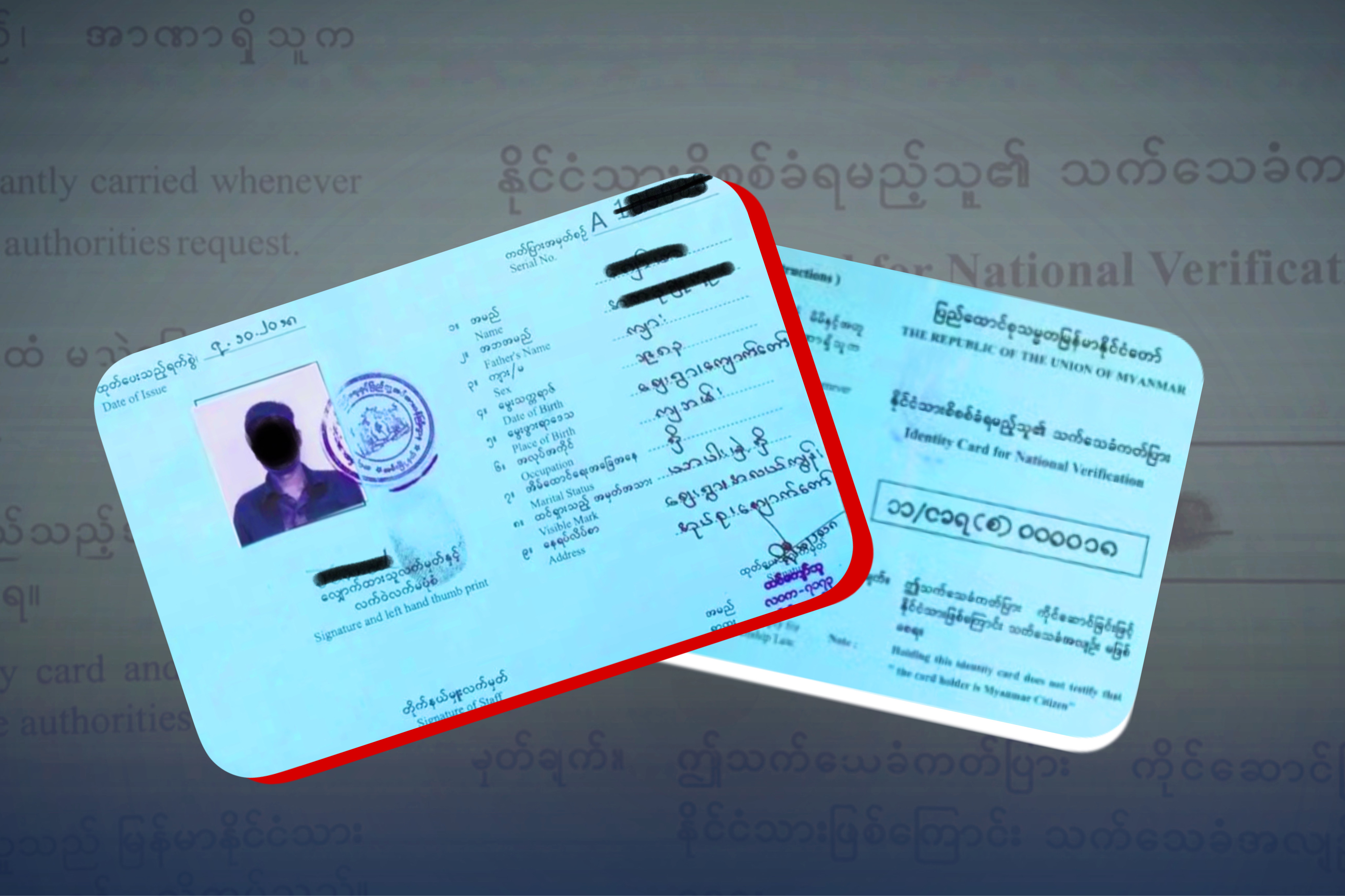
For decades, Myanmar has stripped the Rohingya of their citizenship one identity card at a time, from full citizens to “temporary residents” to “Bengali” applicants. Here is what you need to know about the National Verification Card (NVC), the latest of them: who introduced it, how Rohingya were forced to accept it, and why they call it the “genocide card”.

National Verification Card
For decades, successive Myanmar governments have stripped the Rohingya of their citizenship, one identity card at a time.
After independence, in the early 1950s, National Registration Cards (NRCs) were issued for the first time. In a pilot project covering two townships, Thanlyin in Yangon Region and Maungdaw in Rakhine State, all Rohingya residents received the cards. From then until the enactment of the new citizenship law in 1982, only two types of identity document were available: the National Registration Card and the Foreigner Registration Card. No Rohingya were issued a Foreigner Registration Card.
In 1974, the military government led by dictator Ne Win launched an operation to confiscate National Registration Cards (NRCs) and other identity documents from Rohingya in northern Rakhine State. The campaign lasted four years. In 1978, it ended in the first large-scale wave of violence against the Rohingya, known as Operation Dragon King (Naga Min), in which about 250,000 people were driven out of the country as “illegal Bengali immigrants” from Bangladesh. Within months, most were repatriated, with the authorities acknowledging them as Rohingya.
As the military government failed in its plan to expel the Rohingya population, it enacted a new citizenship law in 1982 that rendered them stateless in their own country by excluding them from the list of officially recognized “national races” or “ethnic groups.” This was despite the availability of primary-source historical evidence that the Rohingya had been settled in the country long before British colonization.
In 1989, the new military government began enforcing the 1982 citizenship law and asked the Rohingya to apply for new, pink-coloured citizenship cards. Applicants were required to attach their old NRCs to the application. Instead of issuing the new citizenship cards, however, the authorities in mid-1994 issued applicants a Temporary Registration Card, widely known as the “White Card,” which listed their race as “Bengali.” The card downgraded the Rohingya from full citizens to temporary residents. It was invalidated in 2015 by the quasi-civilian government led by former General Thein Sein. All cardholders were required to return their cards and were given a receipt confirming the return.
What replaced them was the National Verification Card, or NVC. Here is what you should know about it.
What is the NVC?
NVC stands for National Verification Card. It is a light blue identity card issued by Myanmar’s immigration department to people the state says have not yet proven they are citizens. Rohingya call it the “genocide card”.
The card’s own wording settles the citizenship question. Its back states, in both English and Burmese: “Holding this identity card does not testify that the card holder is Myanmar Citizen.” It also says the holder needs to apply for citizenship under the Myanmar Citizenship Law. The card shows no ethnicity, but the application form does. It asks for race and religion and for the date and route of “arrival in Myanmar”. Rohingya is not an accepted answer, so applicants are recorded as “Bengali”, the state’s term for people it says came from Bangladesh. Smaller numbers of NVCs were also issued in Shan and Kayin states, but in Rakhine the card was aimed almost entirely at Rohingya.
How it began
The card was created under President Thein Sein, a former general who led Myanmar from 2011 to 2016. Among his advisers in those years was Dr. Kyaw Yin Hlaing, who had earlier served as secretary of the government’s Rakhine Inquiry Commission. Its April 2013 report called Rohingya “Bengalis” and said their citizenship should be decided under the 1982 law, unchanged. “To grant the citizenship to Bengalis, we’ve recommended to stick to the 1982 Citizenship Law,” he told reporters. He was an adviser to the president from 2013 to 2015, the years when that approach was turned into a card.
The plan was first tested in the camps. After the state-sponsored violence in 2012 drove well over 150,000 Rohingya into displacement camps, officials began registering them as “Bengali” or “Bengali/Islam”. In June 2014, the immigration department opened a pilot in Myebon township where it accepted citizenship applications only from people who identified as Bengali. Of 1,094 applicants, 209 were declared eligible in September 2014, most of them Kaman, a recognised Muslim group, and 169 of them only as naturalised citizens. The pilot was soon suspended after protests by Rakhine nationalists.
The same year, Rohingya in parts of Rakhine were told they would not be counted in the national census unless they identified as Bengali. Officials later said only about 20,000 of roughly a million had been counted. A leaked draft Rakhine State Action Plan went further: any Rohingya who refused the “Bengali” label would be placed in a category denied the right to be considered for citizenship.
The last obstacle was the white card, which still let Rohingya vote. In February 2015, parliament approved letting white card holders vote in a planned constitutional referendum. Buddhist nationalist groups, including monks, protested in Yangon, and within hours, on February 11, Thein Sein declared the cards invalid from March 31. Holders had to surrender them by May 31, and about 400,000 were collected by the deadline. In return, they were handed paper receipts that carried no rights. Immigration minister Khin Yi said those who gave up their cards would get new documents.
Those documents came in June 2015: the green “Identity Card for National Verification”, valid for two years and given only to those willing to be described as Bengali. By mid-July, only about 1,600 Rohingya had taken it. In November 2015, Rohingya were barred from voting or standing in the national election.
The NVC under the NLD
Aung San Suu Kyi’s National League for Democracy took power in 2016 and kept the scheme. It renamed the green card the National Verification Card, dropped the ethnicity and religion fields from the card itself and removed the expiry date. The application still required Rohingya to register as Bengali.
The new government also built machinery to speed it up. In February 2017, President Htin Kyaw formed a steering committee to issue NVCs in Rakhine, chaired by immigration minister Thein Swe. Field teams were sent village to village “according to the instructions of the State Counsellor”, her spokesman Zaw Htay said. After the Kofi Annan-led advisory commission urged faster verification under the 1982 law in August 2017, social welfare minister Win Myat Aye was put in charge of accelerating the process.
The pressure peaked just before the violence. The UN Fact-Finding Mission found that soldiers and border police held aggressive meetings with Rohingya elders in mid-August 2017 demanding they accept the card, in villages where some of the most brutal “clearance operations” later took place. More than 740,000 Rohingya were driven into Bangladesh.
The military that seized power in 2021 kept the card and has continued to force Rohingya to take it.
How Myanmar forced Rohingya to accept it
Most Rohingya refused the card. The state answered by making daily life impossible without it, step by step.
It was sold as a path to citizenship: Government and immigration offices promoted the NVC as a legal card and “the first step” towards citizenship. Leaflets printed in Burmese, English and Bengali told Rohingya that an NVC holder “is not foreigner” and that only with the card would “the socio-economic development of your life time” be guaranteed.
Movement was locked behind it: Rohingya without the card could not travel from village to village or town to town. To leave their township, they needed a travel permit known as Form 4, enforced at checkpoints. “We use Form (4) as a control mechanism for non-citizens,” said Nanda Hla Myint, a spokesman for Thein Sein’s former ruling party. At checkpoints, Rohingya without the card were beaten, extorted and sent back, and told they must take it.
Work depended on it: In many Rohingya villages, people were not allowed to fish or to work unless they took the card. Rohingya working for aid agencies were told they would not be rehired without it.
Prisoners left with it: Detained Rohingya were beaten and starved until they accepted the card, and many were given it on release. In 2018, 62 pardoned Rohingya prisoners were taken to a border police compound and made to accept NVCs under threat of re-arrest.
Force was used when pressure failed: In many Rohingya villages, soldiers forced families to accept the card at gunpoint, and those who refused were beaten and threatened with death.
It became the price of going home: Every repatriation plan between Myanmar and Bangladesh since 2017 has made the NVC compulsory for returnees. In July 2019, foreign ministry permanent secretary Myint Thu led a delegation to the camps in Cox’s Bazar to push the card, telling reporters that Rohingya “may not be entitled to full-fledged citizenship” but could apply for naturalised citizenship.
What the card means today
Under military rule, Rohingya still need the NVC at almost every step: to apply for any citizenship card, to travel beyond their village or township, to work and to deal with officials. The military continues to enforce it just as the governments before it did. And the logic has not changed. A person only needs to apply for citizenship if they are not already a citizen, and every Rohingya who takes the card is recorded as exactly that.