"The tears of Rohingya mothers, left feeling as though their sons had never even existed in this world, could be mistaken for a small stream."

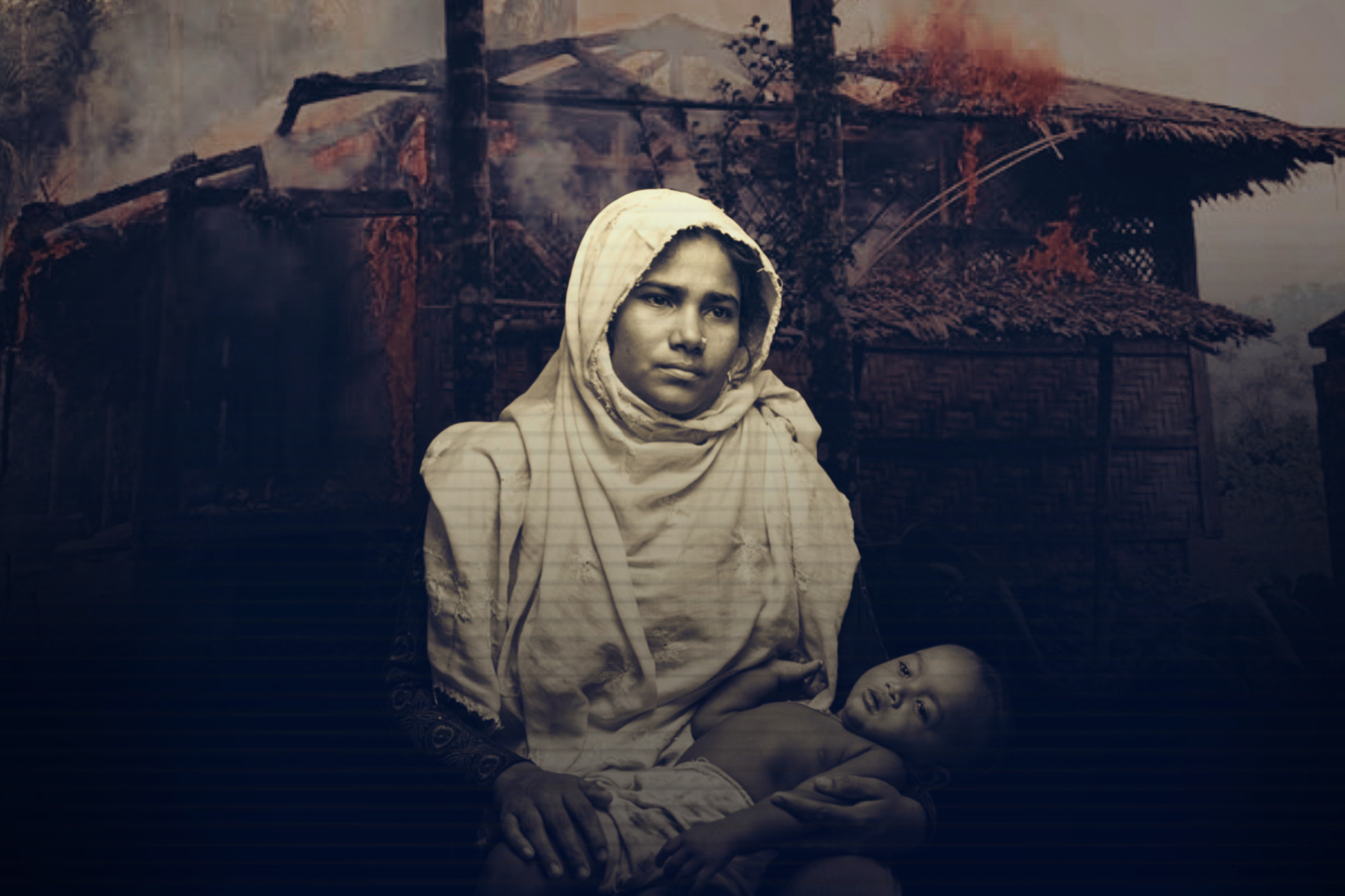
Rohima Khatun, 25, with her child, August 2018 (Photo: MSF)
One morning in 2023, I woke after a very short night’s sleep to a phone call from my village. My village was being attacked; dozens of people had been injured, and some had already died. Weeks later, more news reached me, and my heart broke. I wrote this piece to tell what is perhaps only 0.1 percent of what I heard.
Wherever you go, there are only Rohingya dead bodies; whoever fights, it is the Rohingya who die. Arakan, once a land of diverse peoples who lived together in unity and harmony, has become a barren wasteland of burned-out villages and homes. It has become like a vast graveyard, piled high with the bodies of the dead.
In an age when people can travel the world without even leaving their homes, Rohingya parents cannot get news of their own children, living only kilometres away. Living out their days too terrified even to step outside to see who is dead and who is still alive, the Rohingya are dying in the grip of severe famine. The little daughter, who steps outside wondering why her father has not returned from the market, is shot dead. The elder brother, who goes to pick up his younger sister from school, is arrested. Others are fighting their own war, a war that has nothing to do with me, yet the guns and the bombs come to my very door, sending my children to the grave. Parents who spent years tenderly raising a child are left feeling as if that child had never even come into this world.
Rohingya families, who struggle all day under the scorching sun, now dread the arrival of night. As darkness falls, the sound of gunfire begins to haunt them like ghosts. The flashes of bursting bombs are so bright they could be mistaken for the break of dawn. The five-year-old child, who steps out of the house only to relieve herself, dies on the spot, without even a cry being heard. Once again, the nightless days stretch on endlessly.
The military forces, losing battles everywhere and unable to hold on to even their own camps, are dragging the Rohingya away, forcibly arresting them and throwing them into the front lines of battle, to their deaths. In the football match they are playing among themselves, the Rohingya have become the ball kicked around in between. Unable to find even rice porridge without salt or water, the Rohingya are forced to pay “fines” of 100,000 or 200,000 kyat just to avoid being conscripted into the army. When there is no son, they take the father; when there is no father, the mother is beaten. The plight of Rohingya life is beyond words to tell or write. The Rohingya mother whose son was taken away and killed by their own hands does not even know in which town or village his body lies, or whether it has been left behind for the crows to eat. The tears of Rohingya mothers, left feeling as though their sons had never even existed in this world, could be mistaken for a small stream.
Unidentified corpses lie everywhere, drying out without even rotting; even the vultures seem weary of them. Young Rohingya who have never held anything more than toy guns are forcibly seized, handed weapons, given hasty training and sent to the front lines, losing their lives without even knowing who the enemy truly is. With a tiger in front and a lion behind, the helpless Rohingya trapped in the middle must go running whenever anyone calls, and crouch to do whatever anyone orders. Fearing the tiger, they turn to the guardian spirit, only to find the guardian spirit worse than the tiger.
The wealthy Rohingya, who once had enough to eat comfortably for an entire year without ever leaving home, are now begging others for a plate of plain rice without curry. Confined within the very ancestral villages where their umbilical cords were buried, unable to move about, the Rohingya must wait up to a week just to learn what has happened to their next-door neighbours. How pitiful a life this is, with no one to help or rescue them. The Rohingya sacrifice their lives not knowing who is friend and who is foe; separated from parents and children, entire families perish unnoticed. Countless Rohingya are giving up their lives, with no one left to count the bodies and no one left even to report their deaths.
The “international community” is only something heard of by name. For the Rohingya of Arakan, relief groups remain something never seen with their own eyes, and they can only brace themselves amidst their own cries of grief. Even the organisations that hope “the more they die, the more money comes in” have never wandered into an inland village like this, not even by mistake. In the end, these poor souls can only hold on to one great hope: “Even if I die, together we must reach the end of this revolutionary journey, for the lasting good of the people.”
Originally published in Burmese by DVB on 1 July 2024. English translation by the author.