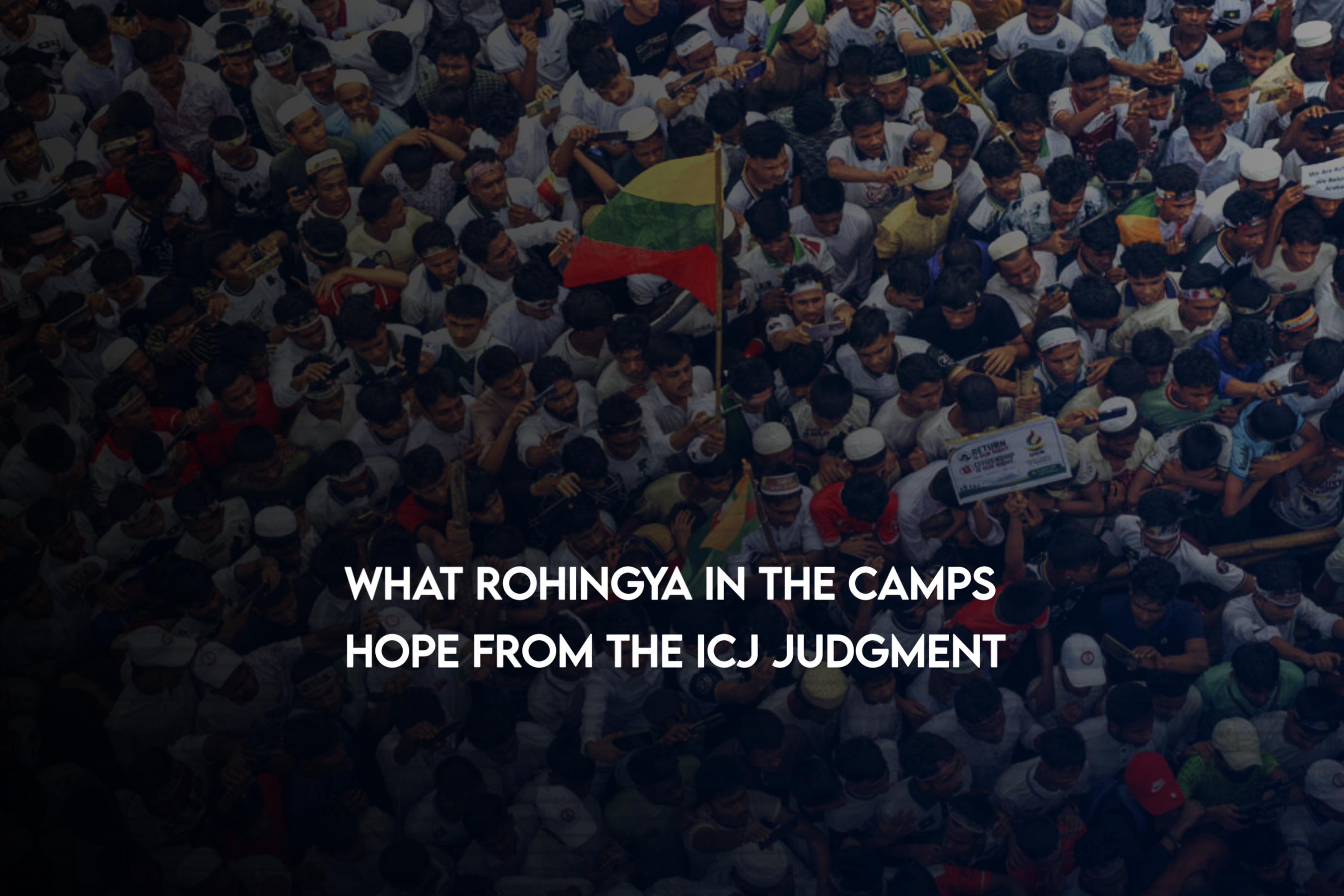
RRF interviewed 32 Rohingya refugees across eight camps in Cox's Bazar, including women, youth, elders, imams, majhis, teachers and recent arrivals, about what they hope the ICJ will say. Nearly half want the court to recognise the genocide. Most of all, they want to go home to Arakan with citizenship, safety and dignity.

Rohingya refugees take part in the ‘Genocide Remembrance Day’ rally to mark the anniversary of their mass exodus. (Photo: AFP)
RRF interviewed 32 Rohingya refugees across eight camps in Cox’s Bazar, including women, youth, elders, imams, majhis, teachers and recent arrivals, about what they hope the ICJ will say.
Nearly half want the court to recognise the genocide. Most of all, they want to go home to Arakan with citizenship, safety and dignity.
The 32 people interviewed included 6 women, 5 young men aged 18–35, 4 older men aged 36 and over, 11 community leaders (imams, majhis and teachers), and 6 recent arrivals who came to the camps between 2024 and 2026.
1. Had they heard about the case?
Most had. 25 of the 32 said yes, 4 had heard a little, and 3 had not heard of it before the interview.
Social media was by far the main source: Facebook, YouTube, videos shared on phones. Others heard from neighbours, family, community meetings, teachers, the mosque or the radio. Several said the January hearings were widely discussed in their blocks.
The three who had not heard of the case were a young man, an imam, and a woman who arrived in 2024. “Today, I know it from you,” the imam told RRF.
2. What do they most hope the court will say?
Nearly half want one thing above all: for the court to recognise that what happened to the Rohingya was genocide.
Of the 32 people interviewed, 15 said their main hope is recognition of genocide. Seven hope most for citizenship and rights, and six for a safe and dignified return. Two want Myanmar to be punished, one hopes for compensation, and one asked for safety for newly arrived refugees.
For many, recognition matters because it ends denial. “It was not any kind of violence, it was genocide,” said a woman in Camp 18. A 23-year-old who arrived recently said he wants “the world to know what actually happened with us.”
Others went straight to what recognition should lead to. “Getting recognized citizenship is not a thing that we want. It’s our right,” said a 24-year-old woman in Camp 7.
A newer fear also came up. A woman who came in 2024 hopes the court will also consider abuses by the Arakan Army, which she called a second wave against the Rohingya. Others named the Arakan Army alongside the Myanmar military when describing why they fled.
3. What do they hope will change for their families?
The answer was almost always the same: to go home. People described a return to their own villages in Arakan, with citizenship, safety and equal rights, not a move to another camp.
Children came up again and again. Parents hope their children can study freely, get healthcare, and build a future. A teacher in Camp 12 hopes to be reunited “with our villagers, relatives and my childhood friends,” and for his child “to study freely without fear.” A young man who recently arrived said his first priority after returning would be to continue his education and help educate others.
Some hope for simpler things too: freedom of movement, the chance to do business, and an end to hate speech against Rohingya. An imam in Camp 3 wants to return to his village, “where I can go mountain freely.”
Not everyone expects much to change. A majhi in Camp 12 pointed out that the ICJ cannot arrest anyone, so he expects only that the world will see the Rohingya as genocide victims and that some countries may cut trade with Myanmar. A recent arrival in Camp 7 said simply: “I don’t know, but I hope something will go well.”
4. How will they feel if the decision disappoints them?
Sad, upset and hopeless were the words most people used. Many have now spent nine years in the camps, and some fear a negative decision would end their hope of ever returning. “It’s like a nightmare for me,” said a young woman in Camp 7.
Some fear they will stay refugees forever. “Maybe we need to become a permanent refugee,” said a woman who arrived recently. An imam in Camp 12 expects people would try to move to other countries, and an older man in Camp 18 worried most about the next generation of Rohingya children.
But many said they would keep going peacefully. Several said they would respect the decision and try again, through other courts or by asking the international community to keep up pressure on Myanmar. “We ask for justice with patience, not with anger,” said an imam in Camp 18. A young recent arrival said he would never lose hope and would keep raising his voice “hopefully and peacefully.”
A small number of young men and one community leader warned that if justice fails, some Rohingya may turn to armed struggle. This was a minority view, but it shows how much frustration has built up after years of waiting.
5. Their message to the judges and the world
The most common message was simple: we are human beings, and we want to go home.
“We are human, we have rights and we deserve to live like humans and we deserve to have our own country.” — Young man, 21, Camp 7
“We are people with a history, but Myanmar is trying to erase it.” — Woman, Camp 18
“We don’t want to remain refugees forever. We have our future to fulfill our dreams.” — Young man, 23, recent arrival, Camp 18
“Please give our children a chance to have a better future in our own homeland.” — Imam, 37, Camp 3
“Please think of the people who only just arrived in the camp. We are still afraid.” — Woman, recent arrival, Camp 18
“Justice for the Rohingya is justice for all people who are denied their rights.” — Imam, 51, Camp 18
Others asked the world not to forget them, to keep its attention on the case, and to make sure no return happens without safety and citizenship. One woman in Camp 12 also asked for more food rations, saying families are struggling to meet basic needs. A recent arrival in Camp 7 had only four words: “I have no hope.”
A note on the interviews
RRF carried out all 32 interviews on 17 November 2026 in the Rohingya language, and recorded the answers in English. Quotes are given as recorded during the interviews, with only small spelling fixes. People are identified by group, age and camp rather than name, to protect their privacy.
RRF chose people who seemed informed and engaged with the issue, so these views reflect active community members rather than the whole camp population. The main hope for each person was matched to the closest category after they answered in their own words.
Download the full PDF here: rohingyaresearch.org/icj-camps-report